For almost two millennia, Christianity expanded outward from a small Jewish sect within the japanese Roman Empire to turn into the world’s largest faith. Imperial endorsement within the 4th century, medieval missionary networks throughout Europe and later colonial-era evangelisation within the Americas, Africa and components of Asia steadily widened its attain. By 2020, it nonetheless accounted for the largest share of humanity, 28.8% of the worldwide inhabitants, or about 2.3 billion folks. But the most recent demographic evaluation from the Pew-Templeton International Spiritual Futures challenge exhibits a quieter transformation beneath that headline dominance. Christianity remains to be rising in uncooked numbers, however shrinking proportionally, dropping followers in dozens of nations whereas increasing quickly in others, and shifting geographically away from its historic European base towards sub-Saharan Africa. The findings draw on greater than 2,700 censuses and surveys throughout 201 nations and territories, monitoring spiritual change between 2010 and 2020 and inspecting the forces driving it, particularly fertility patterns and spiritual “switching,” folks leaving the religion in maturity.
From imperial faith to international majority
Christianity’s early unfold relied on itinerant preachers and tightly knit communities providing social assist and the promise of common salvation. Its trajectory modified dramatically after Emperor Constantine legalised the religion in 313 AD, and later when it grew to become the Roman state faith. Medieval missions carried it throughout Europe, and from the fifteenth century onward European enlargement exported it worldwide. Colonial powers, Spain, Portugal, Britain, France and Belgium, typically paired territorial enlargement with conversion. Missionaries established faculties and medical companies, translated scripture and, in some areas, used coercive programs of taxation and regulation to suppress indigenous religions. By the fashionable period, Christianity had turn into a worldwide majority religion throughout a number of continents.
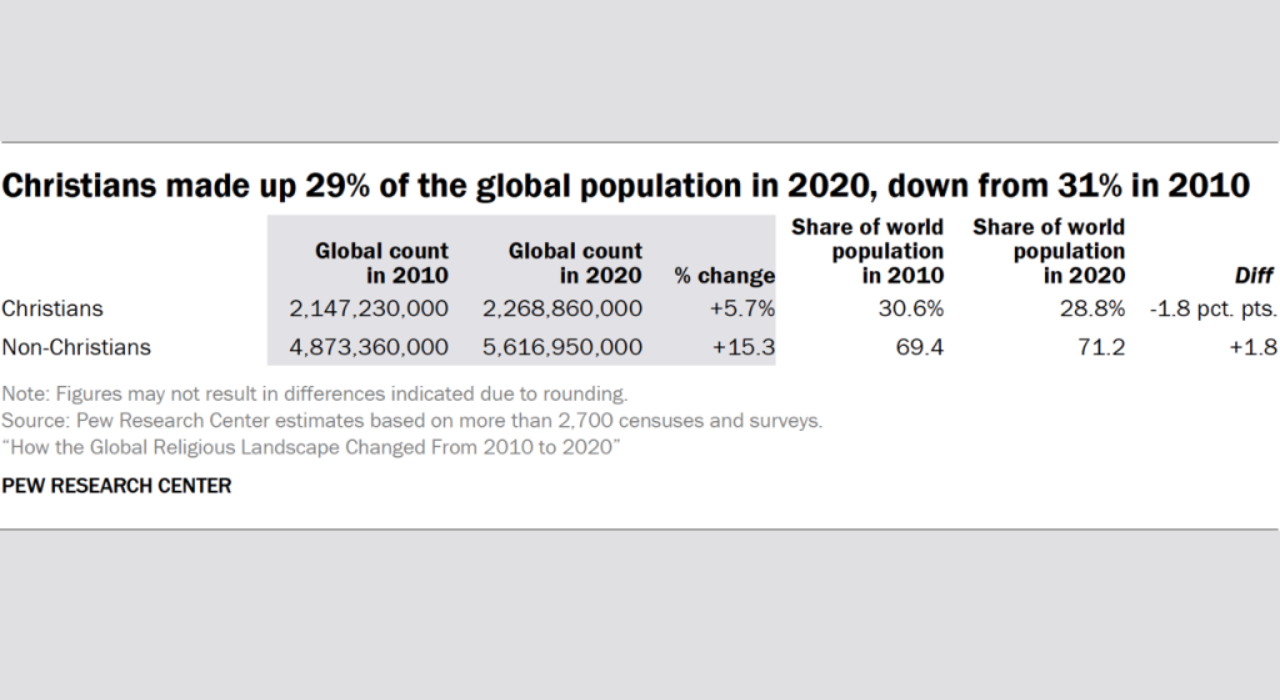
From 2010 to 2020, Christianity grew by 6%, from 2.1 billion to 2.3 billion, remaining the world’s largest faith.
That lengthy enlargement explains its up to date scale. Between 2010 and 2020 the variety of Christians nonetheless rose by 122 million, from 2.1 billion to 2.3 billion, a 6% enhance. However the international inhabitants grew sooner, and non-Christians grew by 15%, inflicting Christianity’s share to fall from 31% to twenty-eight.8%, with all Christians counted below a single class, together with Catholics, Orthodox Christians, and Protestant denominations resembling Baptists, Lutherans, Anglicans, Methodists, and Pentecostals.
The geographic shift: Africa rises as Europe declines
The last decade’s most placing change is geographic fairly than numerical. Christianity’s historic centre of gravity, Europe, not holds the most important Christian inhabitants. The quantity (or depend) of Christians fell in two areas. In Europe, Christians declined to 505 million (down 9%). In North America, they shrank to 238 million (down 11%). In each different area, the variety of Christians grew. The depend elevated most in sub-Saharan Africa, to 697 million (up 31%).
By 2020, 31% of all Christians lived in sub-Saharan Africa, in contrast with 22% in Europe. Latin America and the Caribbean accounted for twenty-four% of worldwide Christians, and North America 10%.
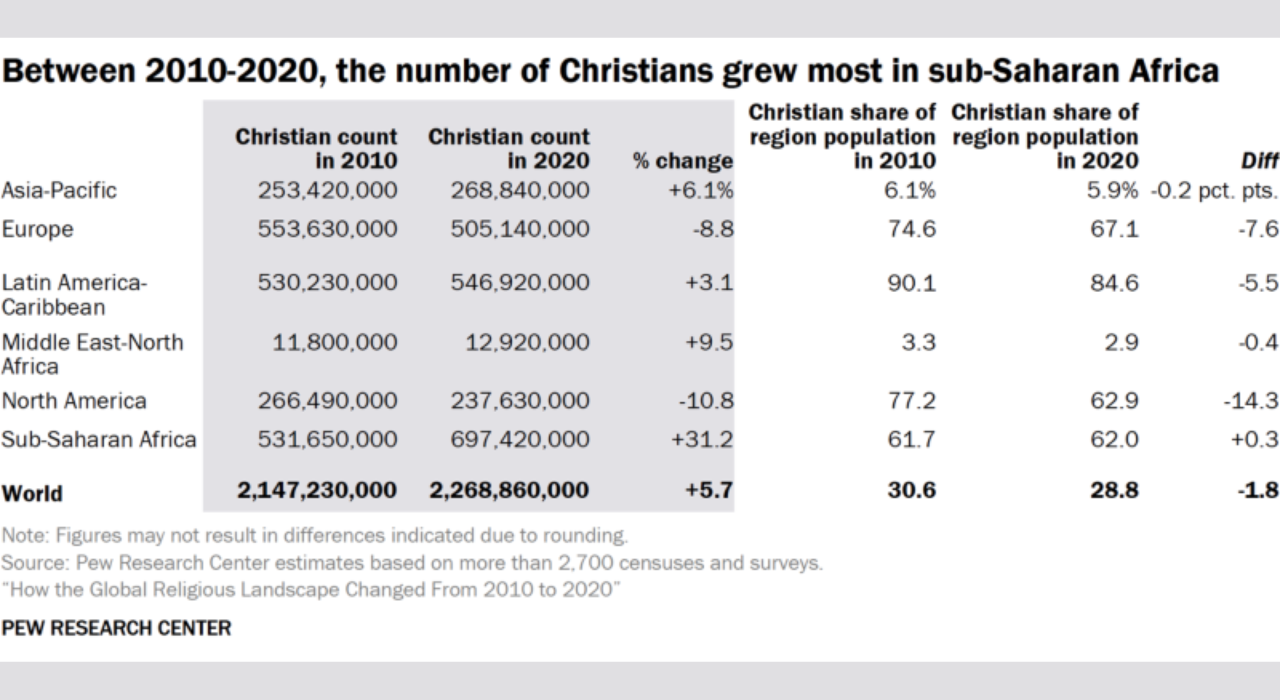
Between 2010 and 2020, Christianity in sub-Saharan Africa grew 31%, reaching 697 million adherents.
The share of populations figuring out as Christian additionally shifted:
In Asia-Pacific and Center East–North Africa areas, Christians remained below 10% of the inhabitants, declining by lower than one level.
By 2020, North America had about 238 million Christians, roughly 10% of the world’s whole Christian inhabitants.
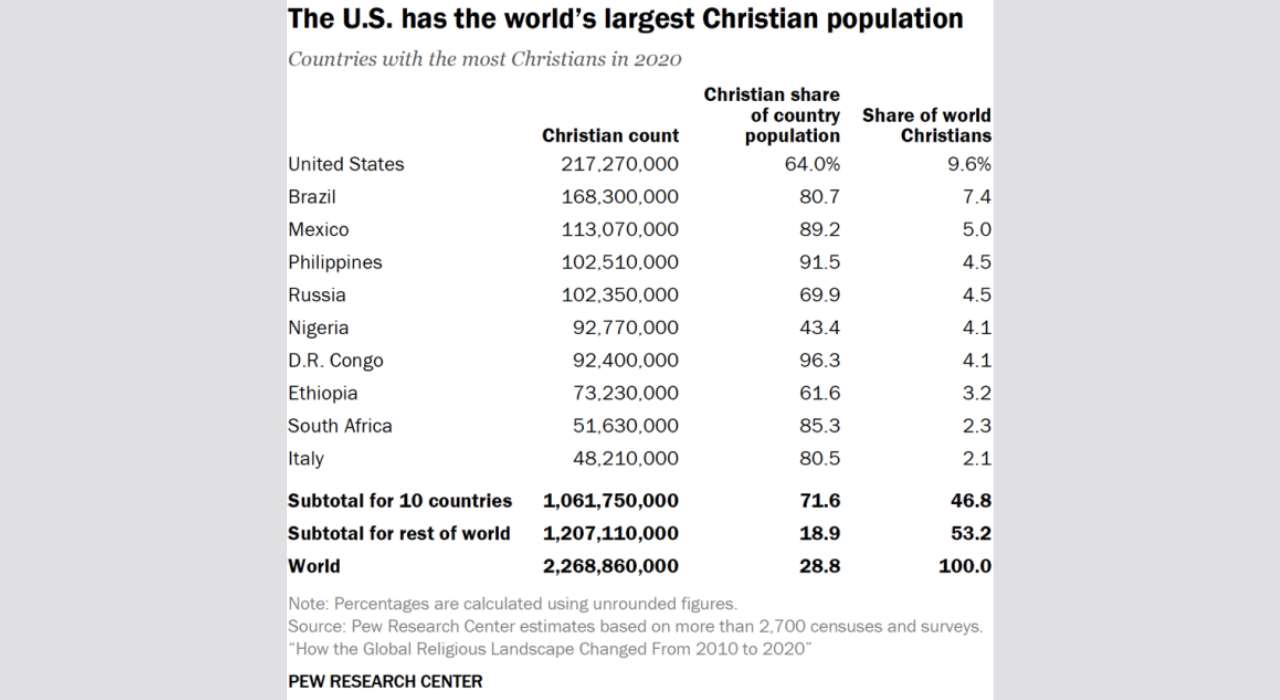
Nevertheless, when measured by particular person nations fairly than areas, the US nonetheless has the most important Christian inhabitants in any single nation. About 64% of Individuals recognized as Christian in 2020, roughly one-tenth of all Christians worldwide.Additionally learn: Is faith declining? 1 in 4 worldwide now non-religious, turns into third-largest group as Christianity falls
The place Christianity declined, and the one place it grew
Substantial change (outlined as not less than a five-percentage-point shift) occurred in 41 nations, greater than for every other faith. In all however one, Christianity declined. The biggest drops:
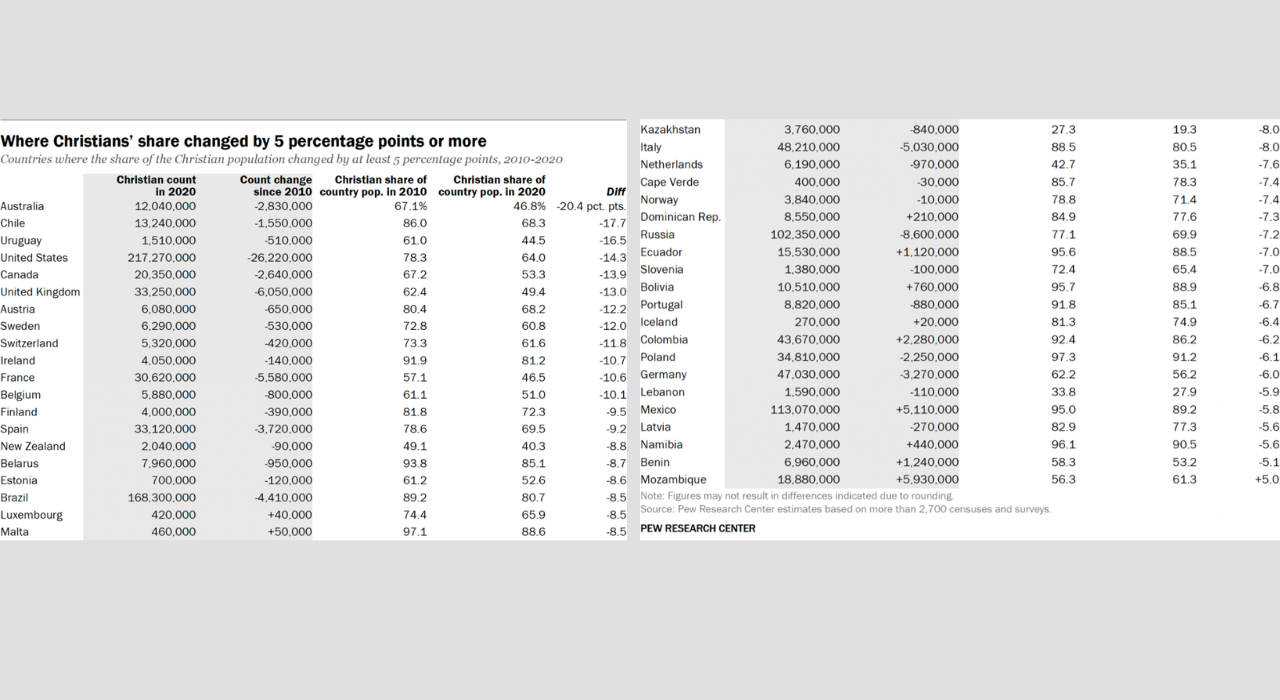
Between 2010 and 2020, the share of Christians in North America fell 14 factors, whereas Europe dropped 8 factors.
In a number of nations Christianity misplaced majority standing:
In every case, religiously unaffiliated folks rose to 40% or extra of the inhabitants. Mozambique was the one nation with a considerable enhance, rising 5 factors to 61%, following the tip of an anti-religious authorities marketing campaign within the Nineteen Eighties. Total, Christians remained the bulk in 120 nations and territories, down from 124 in 2010.
The mechanism: switching out of faith
The central driver of change was not delivery charges alone however spiritual switching. Christians skilled the most important internet losses: For each 1 one who joined Christianity, 3.1 left it. Most didn’t be part of one other faith; they grew to become religiously unaffiliated. This motion explains each Christianity’s declining share and the simultaneous development of the “nones”. Globally, spiritual switching exhibits a transparent path: extra folks go away faith than undertake one. Amongst adults aged 18–54, 3.2 folks go away faith for each one who joins. Fertility nonetheless issues, Christians have comparatively excessive delivery charges, however switching offsets it. Against this, Muslim inhabitants development is pushed primarily by a younger age construction and better fertility, not conversion.
A altering spiritual panorama
By 2020:
Globally, 75.8% of individuals recognized with a faith, whereas 24.2% didn’t.
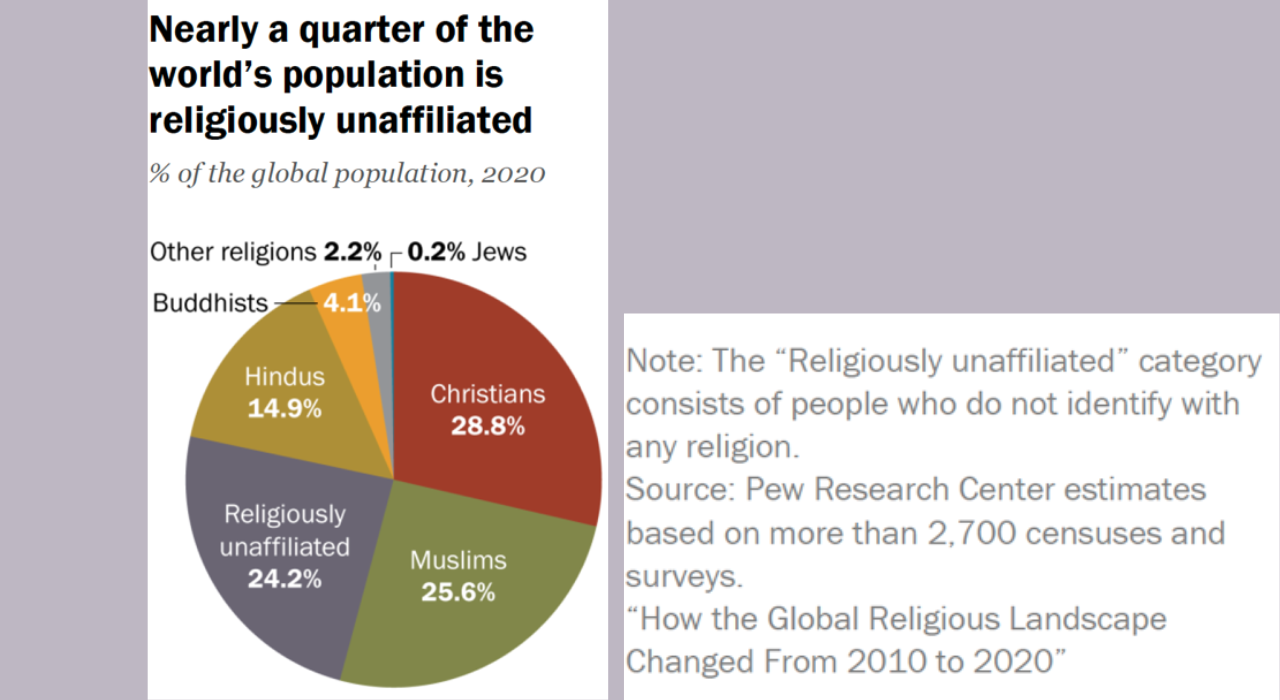
The unaffiliated now make up 24.2% of the worldwide inhabitants, pushed largely by Christian disaffiliation.
The info exhibits Christianity remaining the world’s largest faith, however more and more concentrated within the International South and more and more formed by disaffiliation within the West. Over the previous century it unfold throughout continents; prior to now decade, its centre quietly moved.