


A Spanish conflict galleon that sank in 1708 with royal treasure aboard has impressed three centuries of delusion and authorized battles, and is commonly informally dubbed the “holy grail of shipwrecks.” Now, for the primary time, objects have been introduced up from the Caribbean seafloor.On 19 November 2025, in Cartagena de Indias, Colombian authorities introduced 5 objects recovered from the protected archaeological zone of the San José: a cannon, a porcelain cup, three hand-struck gold and bronze macuquinas, together with two porcelain fragments and related sediment. They’re the primary artefacts ever lifted from the wreck, which sits practically 2,000 ft down and is believed to include some of the helpful cargoes in maritime historical past.The haul is deliberately small, a part of a sluggish, tightly supervised analysis effort known as “In direction of the Coronary heart of the San José Galleon,” which approaches the wreck as a severe underwater archaeological website slightly than a trove to be swiftly raided.
From distant scans to the primary artefacts
Colombia’s venture is structured in phases. The primary, accomplished earlier this yr, was intentionally “non-intrusive”: robotic surveys, imaging and mapping to know how the ship’s stays and cargo are unfold throughout the seabed, how the hull has collapsed, and the way the supplies are deteriorating. These surveys confirmed two issues that matter loads on this world: the location remains to be largely undisturbed by human exercise, and the primary hull and scattered particles fields could be clearly distinguished. In different phrases, nobody has secretly been down there cherry-picking cash or cannons. The second section, now beneath means, is extra hands-on. Utilizing remotely operated autos deployed from Colombian Navy vessels, the staff retrieved a small, rigorously chosen group of objects:
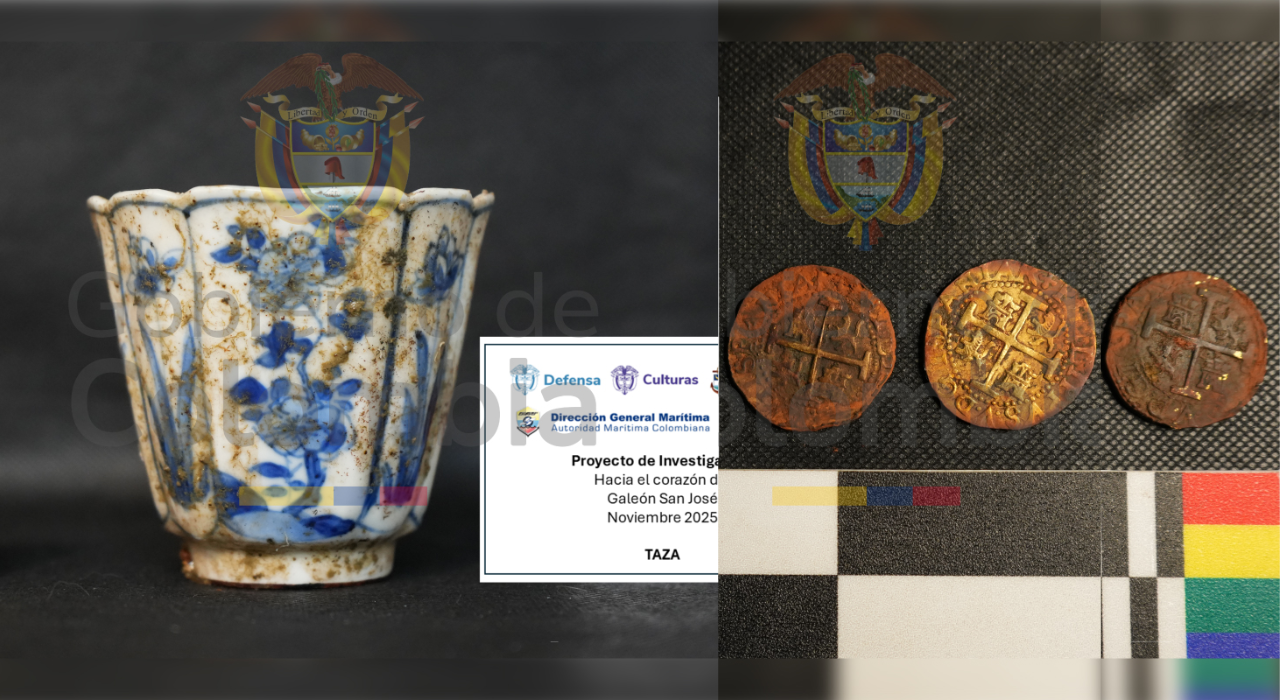
Colombia has recovered some treasures from a 300-year-old shipwreck known as the San José together with a porcelain cup, cash and a canon. (Colombia Ministry of Tradition)
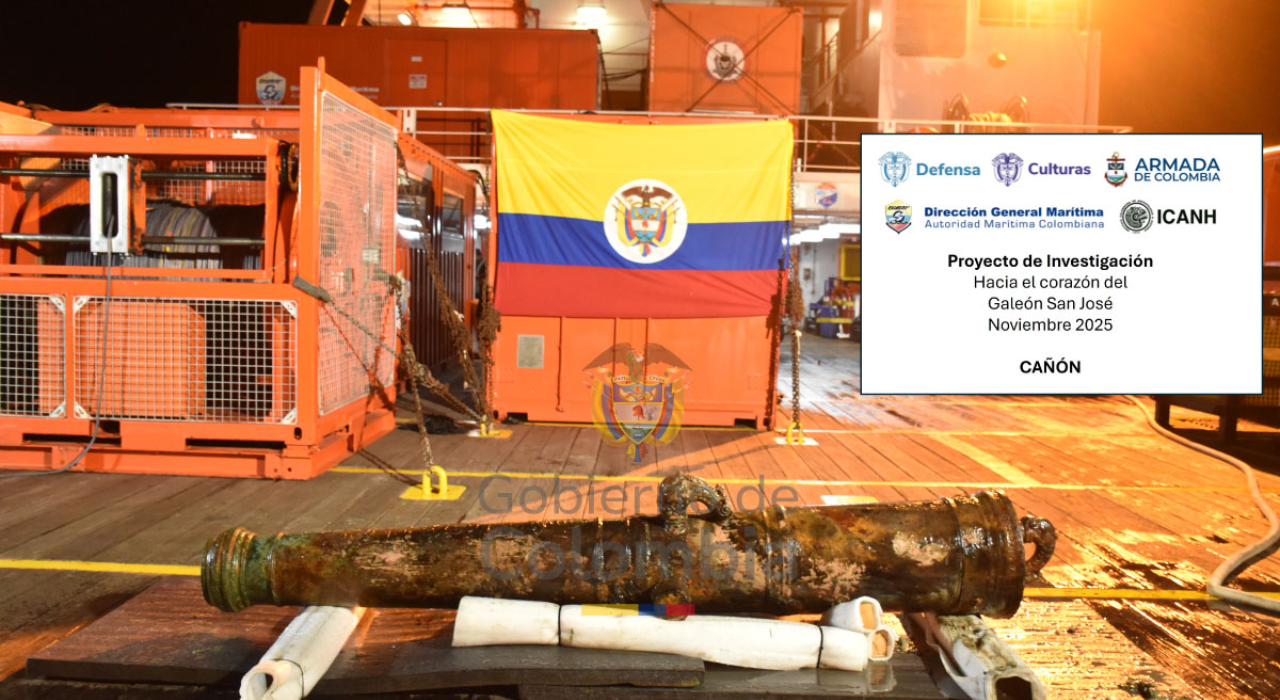
A large cannon was additionally recovered (Ministerio de Cultura)
In line with Colombia’s Ministry of Tradition and officers quoted by CNN, the cash embrace gold and bronze macuquinas, the type of manually minted foreign money utilized in Spanish America between the sixteenth and mid-18th centuries. Most of the cash discovered on earlier dives carry an “L” mark, indicating they had been struck in Lima, with some dated to 1707 – a good match with the ship’s closing voyage. As quickly as they reached the floor, the objects had been stabilised: slowly tailored from high-pressure, salt-water situations to life in air, in order that they don’t crumble or corrode. They’re now in a conservation lab, the place archaeologists and supplies scientists will run what they name archaeometric analyses, basically, lab checks that reveal composition, origin, date and manufacturing methods. These particulars matter. Mint marks and dates on the cash can pin down the place they had been produced. Porcelain glazes and clay signatures could be for example, matched to particular Chinese language kilns. Metals within the cannon can level to specific foundries or commerce routes. Put collectively, they assist reconstruct how wealth and items moved by way of the Spanish empire at the beginning of the 18th century.There may be additionally the unanswered query of precisely how the San José went down. Historic information say it sank after a battle with British forces, however the mechanics are nonetheless debated. One idea is {that a} cannonball hit the powder journal, inflicting a catastrophic inner explosion. Shut-up research of the cannon and surrounding materials could ultimately help or rule out that situation. Past the ship itself, each knowledge level helps fill within the broader image of Europe’s financial, social and political local weather on the time: which mints had been lively, how cargo was insured and moved, how a lot wealth was being extracted from colonies, and at what human value. Colombia’s tradition minister, Yannai Kadamani Fonrodona, in a press release, known as the raise a “historic occasion” that reveals the state’s rising capability to “defend and promote underwater cultural heritage as a part of Colombian identification and historical past.” The director of the nationwide anthropology institute, Alhena Caicedo Fernández, stated it “opens the chance for residents to strategy, by way of materials proof, the historical past of the San José galleon.”
The “holy grail of shipwrecks”
To grasp why 5 objects have made a lot noise, you must return to June 1708. The San José was a Spanish conflict galleon within the Flota de Tierra Firme, a convoy system that ferried silver, gold, emeralds and items from Spain’s American colonies again to Europe. In 1707, the fleet sailed from Peru and different ports loaded with royal cargo destined for King Philip V: by fashionable estimates, round 200 tonnes of fabric, together with valuable metals and gems. On 8 June 1708, close to Cartagena, the fleet was intercepted by the British Royal Navy throughout the Warfare of the Spanish Succession. Within the battle off Barú, the San José exploded and sank with nearly all its 600-strong crew. Solely eleven persons are thought to have survived. The wreck disappeared into deep water, its actual resting place unknown. Over the centuries, tales of its cargo grew. Trendy estimates for the worth of what lies on the seabed vary extensively, from round $7 billion as much as $17–18 billion in at the moment’s cash, relying on the way you calculate historic costs and curiosity. That’s why the ship has earned its “holy grail” nickname. The wreck’s location grew to become a severe fashionable dispute within the Nineteen Eighties, when US salvage outfit Sea Search-Armada (then known as Glocca Morra) claimed to have discovered it and later sought a share of the treasure. Colombia’s navy, working with worldwide scientists, introduced its personal discovery of the San José in 2015 and has stored the precise coordinates labeled ever since. Sea Search-Armada has taken Colombia to the Everlasting Courtroom of Arbitration, arguing it’s owed round $10 billion, or roughly half the supposed worth of the cargo. Spain has asserted historic rights because the flag state of the ship; Indigenous communities from nations like Bolivia and Peru have identified that a lot of the wealth was extracted by way of pressured labour of their territories. Colombia, for its half, insists the wreck lies in its territorial waters and types a part of its underwater cultural heritage. The present authorities is eager to emphasize science, museums and public historical past slightly than bullion.


